

Canada · federal law and 13 provinces and territories
Offshore Casinos Explained
Canada has no single law for online casinos. It has the Criminal Code, provinces that run their own sites and a First Nations regulator near Montreal. This guide explains where offshore sites such as Golden Tiger sit.
- 4 Apr 2022Ontario opens
- 13 Jul 2026Alberta opens
- Kahnawakeoffshore permits
- C$0tax on casual wins
The short answer
For the player, an offshore casino is a grey area rather than a crime. The Criminal Code lets provinces run or license gambling, and offshore sites have neither, but enforcement has targeted operators, not players. In Ontario and now Alberta, use a regulated site. Elsewhere offshore play is common, but provincial protections do not apply.
On this page
What to do before you sign up offshore
If you have already decided to try an offshore casino, the risk is less about the law and more about who holds your money. Work through these in order:
- Find out what your province allows
Ontario and Alberta have regulated private markets. Every other province has one government site. The table further down covers each one.
- Check the licence on the regulator's own website
Do not trust a badge in the footer. Open the regulator's register and look for the operator's company name and the exact domain.
- Read the withdrawal terms before the bonus terms
Pending periods, weekly caps and verification rules decide how quickly you see your money. At Golden Tiger that means 48 hours pending, the next business day for processing and a C$4,000 weekly cap for large winners.
- Open the account in Canadian dollars
Most offshore casinos fix the account currency at registration. A US-dollar account turns every deposit into a conversion.
- Deposit with a method you can trace
Interac e-Transfer is the default Canadian rail. Credit cards often go through as a cash advance, with a fee and interest from the first day.
- Set a deposit limit on day one
Offshore sites are not covered by your province's self-exclusion scheme, so the casino's own tools are the ones that count.
What it means for you as a player
Playing on a site with no provincial licence mostly changes what happens when something goes wrong. A provincial regulator such as the AGCO in Ontario can order a registered operator to fix a problem, and it runs complaint and self-exclusion schemes that cover every site on its list. None of that reaches an offshore casino. Your route is the operator first, then whichever regulator issued its permit, and that regulator applies its own rules, not your province's.
Your bank sees it differently as well. Many Canadian card issuers flag gambling merchants and some block them outright; where a credit card payment goes through, it is usually treated as a cash advance. Debit and Interac e-Transfer are the methods that behave most predictably.
Tax does not change: for someone who plays for fun, casino winnings in Canada are generally treated as windfalls and are not taxed, whether they come from a provincial site or an offshore one. The exception is a person who gambles as a business, which is rare and decided case by case.
Geolocation is the last practical difference. Regulated Ontario sites check where you are during the session. Offshore casinos usually ask for your address at sign-up and verify it with documents, and they close accounts that use a VPN to hide the real location.
Protections you keep and protections you lose
An offshore account is not unprotected. It is protected by different rules. This is how the balance looks for a site like Golden Tiger:
- You keep: a regulator
Kahnawake can act on complaints against its permit holders and publishes its register.
- You keep: tested games
Slots and tables come from studios whose games are certified by testing labs; Golden Tiger also shows an eCOGRA seal.
- You keep: tax-free wins
Casual winnings are not taxed in Canada, wherever they come from.
- You lose: provincial complaints
The AGCO, AGLC and IGCO have no power over an offshore operator.
- You lose: provincial self-exclusion
Ontario's and Alberta's schemes cover their own registered sites only.
- You lose: local ad and bonus rules
Ontario's limits on bonus advertising and inducements do not apply offshore.
The rule itself: what the Criminal Code says
Gambling is a criminal law matter in Canada. The Criminal Code bans most forms of it and then carves out exceptions. The key one is section 207(1)(a), which lets a province conduct and manage lottery schemes, including those run on or through a computer. That is the legal basis for PlayNow, OLG.ca, Loto-Québec and the Ontario and Alberta markets.
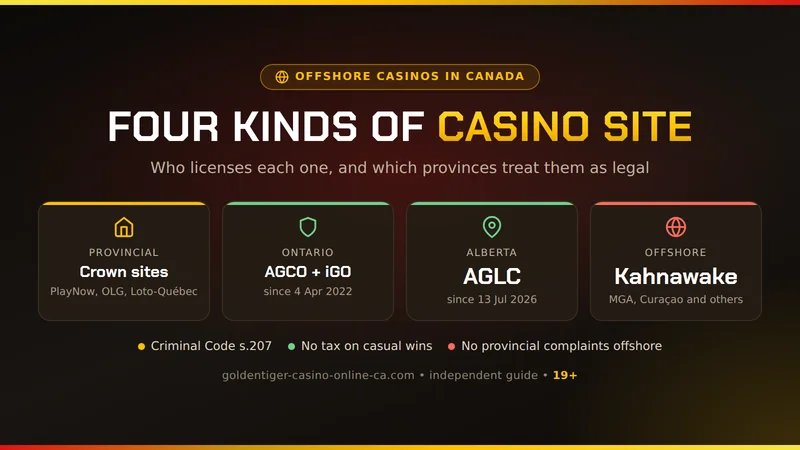
Nothing in the Code licenses a foreign company to offer casino games to Canadians. Offshore operators rely on the argument that their servers and companies sit outside Canada, and Canadian authorities have tended to act against the businesses, not the players. You will meet four kinds of site:
- Provincial government sites
PlayNow (BC, Manitoba, Saskatchewan), OLG.ca, Loto-Québec, PlayAlberta and Atlantic Lottery. Run by crown corporations under s.207.
- Ontario-registered private sites
Registered with the AGCO and contracted to iGaming Ontario since 4 April 2022. Only legal for players physically in Ontario.
- Alberta-registered private sites
AGLC registration plus an agreement with the Alberta iGaming Corporation, live since 13 July 2026.
- Offshore sites
Licensed by Kahnawake, Malta, Curaçao or others. Golden Tiger is one of these, on a Kahnawake permit held by Fresh Horizons Ltd.
Kahnawake is a special case. The Kahnawake Gaming Commission was set up in 1996 in the Mohawk Territory of Kahnawà:ke, south of Montreal, and has issued interactive gaming permits since 1999. It regulates from inside Canada under the community's own jurisdiction, which the federal and Quebec governments have never formally recognised as a gaming licence under the Criminal Code. For a player, that means a real regulator with a public register and a complaint process, but not a provincial one.
Sports betting follows the same logic. Single-event wagering became legal on 27 August 2021, when Bill C-218 amended the Code, but only through provincial sites or provincially regulated operators.
Province by province
Where you live decides which sites are regulated for you. Ages are the minimum for provincial gaming.
Swipe to see all columns
| Province or territory | Regulated online option | Private operators | Age |
|---|---|---|---|
| Ontario | OLG.ca plus registered private sites | Yes, via AGCO and iGaming Ontario (since 4 Apr 2022) | 19+ |
| Alberta | PlayAlberta plus registered private sites | Yes, via AGLC and Alberta iGaming Corporation (since 13 Jul 2026) | 18+ |
| British Columbia | PlayNow (BCLC) | No | 19+ |
| Quebec | Loto-Québec | No | 18+ |
| Manitoba | PlayNow (Manitoba Liquor & Lotteries) | No | 18+ |
| Saskatchewan | PlayNow (SaskGaming) | No | 19+ |
| New Brunswick, Nova Scotia, PEI, Newfoundland and Labrador | Atlantic Lottery | No | 19+ |
| Yukon, Northwest Territories, Nunavut | No own casino site | No | 19+ |
Offshore sites sit outside every row of this table. Check a province's own gaming page before acting on it; rules change.
Dates and deadlines that changed the picture
Filter the list to see the law changes, the market openings or the payment changes on their own.
- Provinces take over gaming
A Criminal Code amendment gives the provinces exclusive control of lottery schemes, including those run by computer.
- Kahnawake Gaming Commission founded
Set up in the Mohawk Territory of Kahnawà:ke, south of Montreal.
- Kahnawake licenses online gaming
Its interactive gaming regulations open the door to offshore casino permits.
- BCLC adds casino games to PlayNow
British Columbia becomes one of the first provinces with a government online casino.
- Single-event sports betting legal
Bill C-218 amends the Criminal Code; provinces decide how to offer it.
- Ontario's regulated market opens
Private operators register with the AGCO and sign with iGaming Ontario; offshore sites are expected to leave.
- Interac Online retired
Interac e-Transfer becomes the standard bank rail for casino deposits.
- InstaDebit closes
Withdrawals end on 30 April 2026; customers are pointed to Interac.
- BC's new regulator
The modernised Gaming Control Act takes effect and the IGCO replaces the GPEB.
- Alberta's regulated market opens
AGLC registration plus an Alberta iGaming Corporation agreement; a grace period runs to October.
How a sign-up at an offshore site actually goes
We cannot show you screenshots of a live sign-up without an account, so here is the process in words, using Golden Tiger as the example. You enter an email, a password, your name, date of birth and address, and you choose the account currency, which is where you pick CAD. There is no instant ID check against a provincial database the way Ontario sites run one.
Verification comes later, usually at the first withdrawal. Expect to upload photo ID and a recent proof of address, and sometimes a picture of the card or a screenshot of the e-wallet you deposited with. Larger withdrawals can trigger a source-of-funds request. Doing this before you win saves days, because a withdrawal only enters the 48-hour pending window once the account is verified.
Deposits go through the cashier: Interac and iDebit are the Canadian rails, alongside Visa, Mastercard, MuchBetter, Paysafecard and a few vouchers. The welcome bonus attaches automatically to the first deposit unless you decline it, so read the wagering terms first. At Golden Tiger, the first two deposit bonuses carry 200x play-through, and 30x applies from the third.
Sources we used
Every statement on this page comes from one of these, read in September 2026:
- Criminal Code (R.S.C. 1985, c. C-46)Part VII, gaming and betting, including s.207
- iGaming Ontario: regulated marketList of operators and gaming sites in Ontario
- Alcohol and Gaming Commission of OntarioOperator registration in Ontario
- Alberta Gaming, Liquor and CannabisRegistration for Alberta's regulated market
- Government of B.C.: gambling in B.C.PlayNow as the only legal site, IGCO regulator
- Kahnawake Gaming CommissionRegister of interactive gaming permit holders
Offshore casino questions
Is it legal to play at an offshore casino in Canada?
It is a grey area. The Criminal Code only authorises gambling run or licensed by a province, and offshore sites have neither. Enforcement has targeted operators rather than players, but in Ontario and Alberta the regulated sites are the legal choice.
Can I get in trouble for playing at Golden Tiger?
We are not aware of Canadian players being charged for playing at offshore casinos. The practical risk is different: no provincial regulator can step in if there is a dispute over your balance.
Are offshore casino winnings taxed in Canada?
For recreational players, no. Casual gambling winnings are generally treated as windfalls, whether they come from a provincial site or an offshore one. Professional gamblers are assessed differently.
Is a Kahnawake licence valid in Canada?
It is a real licence from a regulator based in Quebec, with a public register and a complaint process. It is not a provincial licence, so it does not make a site legal in Ontario or Alberta.
Why can't I play at offshore sites in Ontario?
Since 4 April 2022 Ontario has its own regulated market. Operators must register with the AGCO and sign with iGaming Ontario, and most offshore brands, Golden Tiger included, are not on that list.
Which payment methods work at offshore casinos?
Interac e-Transfer and iDebit are the Canadian rails; Visa, Mastercard, MuchBetter and prepaid vouchers are common too. Interac Online was retired on 31 May 2024 and InstaDebit closed in 2026, so older guides that list them are out of date.
How do I know if an offshore casino is licensed?
Open the regulator's own register, not the casino's footer, and look for the operator's company name next to the exact domain. For Golden Tiger that is Fresh Horizons Ltd. and goldentiger.casino on the Kahnawake list.

Know the rules and still want to play?
Golden Tiger takes Canadian dollars from C$10 and holds a Kahnawake permit through Fresh Horizons Ltd. The welcome package runs to C$1,500 over five deposits.
19+ (18+ in AB, MB, QC) • Play Responsibly • Get Help